The Conformal Vortex
The birth field lives on a sphere. Flatten it with the oldest honest map in mathematics, and the sphere lies down as a flat Flower of Life — losing not one angle, not one whirlpool. This is the piece where you get to hold the proof in your hands and turn it.
A Field Note from Scalar Flower. With computational collaboration by the Hermes agent (Nous Research).
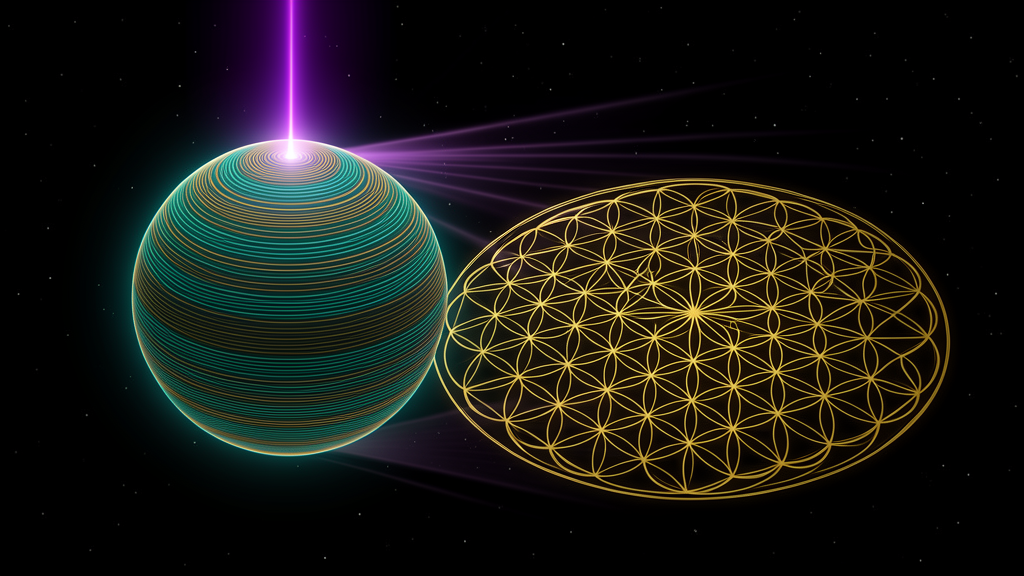
The same object, two views: a sphere of interfering waves on the left, and — flattened through a single point at its pole — the flat flower on the right. Not two things that resemble each other. One thing, seen two ways.
REAL — computed or proven; something you could rerun and check. ARCH — true structure that follows from the real quantities; correct bookkeeping, not a discovery. INTERP — offered meaning; a lens that makes no prediction and cannot be falsified.
In an earlier Field Note — The Waveform Model — the birth chart stopped being a flat wheel of dots and became a field of ten interfering waves, with bright ridges where the waves agree and deep valleys where they cancel. At the floor of the deepest valleys sat tiny whirlpools: points where the field spins around a dead-still center. This piece is about where that field actually lives, and a small miracle that happens when you flatten it.
Because here is something the waveform note glided past: the field was never really flat. Ten planets don't ripple across a tabletop — each one is a wave spreading over the surface of a sphere, the whole sky wrapped around you. The flat pictures were always a convenience. The true home of the field is round.
So a fair question is: if the real object is a sphere, why do we keep drawing it as a flat flower? Is the flat version a lie — a flattened-out approximation, the way a paper map flattens the round Earth and stretches Greenland to the size of Africa? Or is it something better than that?
It turns out to be something better. There is a way to flatten a sphere that gives up almost nothing — a map so faithful it was good enough for the ancient Greeks and is still used, unchanged, in modern physics. This is the piece about that map. And the best way to meet it is to turn it yourself.
ITurn it in your hands
Below is the live instrument. It's a real birth field on its sphere — Walt Whitman's, to start — with the whirlpools marked (teal for one spin, pink for the other) and a violet axis of light through the poles. Drag to turn it.
The important control is the slider at the bottom. Slide it and watch the sphere lie down — unfurl into a flat disc of overlapping circles, a Flower of Life. That unfurling is the map this whole piece is about. Take a moment with it before reading on.
— Switch the person (Whitman / Cayce / Mandorla). Each is a different real chart, computed from the actual sky. The Mandorla is Whitman's and Cayce's fields sung onto one sphere.
— Switch the field mode (Vortex field / Hub field). One shows the whirlpools; the other shows the chart's single deepest signature. Section IV is about the difference between these two figures.
IIThe oldest honest map
Here is how the flattening works — and it's simple enough to picture exactly. Stand at the very top of the sphere, the north pole. Now, from that point, draw a straight line through any other spot on the sphere and let it keep going until it hits a flat floor laid underneath. Wherever the line lands on the floor is where that spot "goes" on the flat map. Do it for every point, and the whole sphere spreads out onto the plane.
This is called stereographic projection, and it's old — the Greeks used it to map the heavens onto flat brass astrolabes two thousand years ago. It has two beautiful properties that almost no other flattening has.
— It keeps every angle exactly. Wherever two lines cross on the sphere at some angle, their shadows on the flat map cross at the very same angle. Nothing is sheared or skewed. A mapmaker's word for this is conformal — shape-preserving. REAL
— It turns circles into circles. Draw any circle on the sphere, and its shadow on the flat map is still a perfect circle — never squashed into an egg or kinked into an oval. REAL
There's a price, and honesty means naming it: stereographic projection badly distorts size. Spots near the north pole get stretched enormously as they race out toward the far edges of the map. It's the same trade every world map has to make — you can be truthful about angles or truthful about areas, never both at once. This map chooses angles. It tells the truth about shape and lies about size.
Every flat map of a round thing lies about something. This one tells the truth about angles and shapes — and that's exactly the truth the field is made of.
IIIWhy the circles staying round is a proof
Now back to the thing you watched in the viewer. As the sphere lay down into the flat flower, the golden circles stayed circular. That isn't decoration. It's the check that the map is honest — a test the picture could have failed, and didn't.
Here's why it matters. The Flower of Life is built entirely out of circles. If our flattening were a fake — a cosmetic "artist's impression" of a projection rather than the real angle-preserving map — then those circles would come out bent: pinched into ovals, kinked at the edges. The fact that they stay perfectly round, all the way through the morph, is the visible fingerprint of a genuine conformal map. You are watching the theorem happen. REAL
And this is why we can say something that sounds like poetry but is actually plain geometry: the sphere and the flat flower are not two things that resemble each other. They are one object, shown two ways. The same field. One drawn round, one drawn flat, with a faithful map carrying each point of one to exactly one point of the other. When we draw the birth field as a flat Flower of Life, we are not approximating the sphere. We are looking at it from the pole. ARCH
The whirlpools make this even sharper. Remember, from the waveform note, that the whirlpools always come in balanced pairs and their spins add up to exactly zero — a conservation law. That counting is a topological fact: it depends only on how the field is connected, not on any distance or size. A conformal map bends every length and wrecks every area, but it cannot add, remove, or flip a single whirlpool. So the count you'd make on the sphere and the count you'd make on the flat flower are guaranteed to be the identical number. The thing the instrument actually measures survives the flattening untouched. REAL
IVTwo fields, two signatures: the churn and the intricacy
Switch the person between Whitman and Cayce and you're looking at two genuinely different fields — and the difference isn't a matter of taste. It's counted. It also lands right on a rule from the waveform note: the more "together" a field is, the fewer whirlpools it spins.
— Whitman's field is diffuse and churning. Its togetherness number — the hub — is low (about 4.5 out of a possible 10), and there's no single center the ten planets agree on. A scattered field like that churns: we count 112 whirlpool pairs on it, one of the busiest fields on the site. There's no ruling voice, but there is a real threefold undercurrent running through it — a triangle pattern, three-ish centers of pull rather than one. For a man whose most famous line is "I am large, I contain multitudes," the geometry is almost on the nose: no single self at the wheel, and a genuine structure holding the many together. REAL
— Cayce's field is more focused, and unusually intricate. His hub is higher (about 5.5), his field more gathered — and being more gathered, it spins far fewer whirlpools: 65 pairs, nearly half Whitman's. But its deepest layer is rare: where most fields lean on their simplest harmonics, Cayce's strongest layer is the fivefold one — a five-petaled inner symmetry that very few charts carry. Fewer whirlpools, but a finer, more ornate weave underneath. REAL
The second field mode — Hub field — is where you see that inner weave. Switch to it and the whirlpools step aside; the sphere lights up with broad bands that show each field's deepest harmonic layer directly. Whitman's shows the loose threefold undercurrent; Cayce's shows the tighter fivefold one. These aren't eyeballed impressions — they come straight from the same wave-arrows that make the hub, read one layer at a time (the layers that, in the waveform note, turned out to be astrology's own aspects). REAL
Whitman: low togetherness, 112 whirlpools, a threefold churn — multitudes. Cayce: more gathered, 65 whirlpools, a rare fivefold weave. Two real fields, and the coherence-versus-whirlpool rule holding on both.
A note on honesty: Whitman's exact birth time isn't known, so his field is cast for noon. We checked that the things claimed here — the diffuse, no-single-center, threefold-undercurrent shape — hold steady no matter which hour of that day you pick, so they're real features of his birth day, not an accident of a guessed clock time. Cayce's time is recorded, so his is exact.
VTwo circles, one lens — where the flower earns its name
A careful reader should be uneasy about one thing, and we want to meet it head-on rather than let it sit. Putting a real, computed field inside a Flower of Life risks a familiar bad move: dressing up a measurement in sacred geometry to borrow its glow, and implying the planets somehow "sit on" the flower's lattice. They don't. We've tested whether the sky fills that kind of geometry, and it doesn't — the Flower of Life here is a chosen frame, not a measured fact. It's a lens we lay over the field, clearly labeled as one. INTERP
But it isn't an arbitrary lens, and there's one real reason it's the right frame rather than mere decoration. The Flower of Life is built from a single repeated shape: two circles overlapping, the almond-shaped lens between them that the old geometers called the vesica piscis. Every circle in the pattern makes that lens with its neighbor. And that same two-circle shape is a real layer of every field — the "twofold" harmonic, a field organized around two centers with a lens opening between them. The flower tiles the vesica everywhere; that twofold layer is one vesica, lit up. They're built from the same primitive. ARCH
The third view in the viewer — the Mandorla — is that idea made literal. It's Whitman's field and Cayce's field sung onto a single sphere: two whole fields, each keeping its own centers, overlapping into one. That overlap-of-two is a vesica at full size — the almond of shared ground that opens only when two circles meet and neither is swallowed by the other. That's why the field feels at home inside the flower: not because planets land on its nodes, but because both are made of the same first move — two circles, overlapping, and the lens born between them. ARCH
Here is a place to step, on purpose and with the label showing, onto more contemplative ground.
Look once more at how the flattening works. You cannot lay the whole sphere flat — there is always exactly one point, the north pole itself, that has nowhere to land. It maps "to infinity." Every other point of the sphere spreads out to fill the endless plane, and that single held-open point is the price of the whole map. Run it backwards and the statement turns luminous: a flat plane, plus one point at infinity, closes up into a perfect whole sphere. Mathematicians call the result the Riemann sphere, and it is the natural home of exactly the kind of wave-with-a-phase the field is made of.
So a finite, closed wholeness can lie all the way down as an endless open plane — losing not one angle, not one whirlpool — as long as one point is kept open to infinity. We offer that as an image, not a mechanism: the sphere becomes a world by keeping one place open. What the flat view seems to lose isn't destroyed; it's carried in that one open point, and the whole round wholeness is recovered the moment you close it back up. INTERP
That's the discipline in one snapshot. What's REAL: the field on its sphere, the stereographic map, the circles that stay round, the whirlpool count that survives the flattening, and the one-voice-versus-two-centers signature. What's ARCH: that the sphere and flower are therefore one object, and that a two-centered field is a vesica. What's INTERP: the Flower of Life as a chosen frame, and the point-at-infinity offered on the far shore. Three levels, kept clearly apart — so we can go all the way into the beauty of this without a single claim we'd have to take back.
Cast your own field, then flatten it
Cast your birth-moment as a living field — free, no sign-up — then turn it, and lay it down into its flower. One object, your sky, two views.
Cast your field, free →