The Universal Whirlpool
The whirlpools in your field are not a quirk of our model. They are instances of the single most universal structure in all of wave physics — the same object that physicists found, independently, in laser light, in hurricanes, and in liquid helium colder than deep space. Same whirlpool, same law, four different worlds. That universality is the honest answer to "isn't it just an artifact?"
A Field Note from Scalar Flower. With computational collaboration by the Hermes agent (Nous Research).
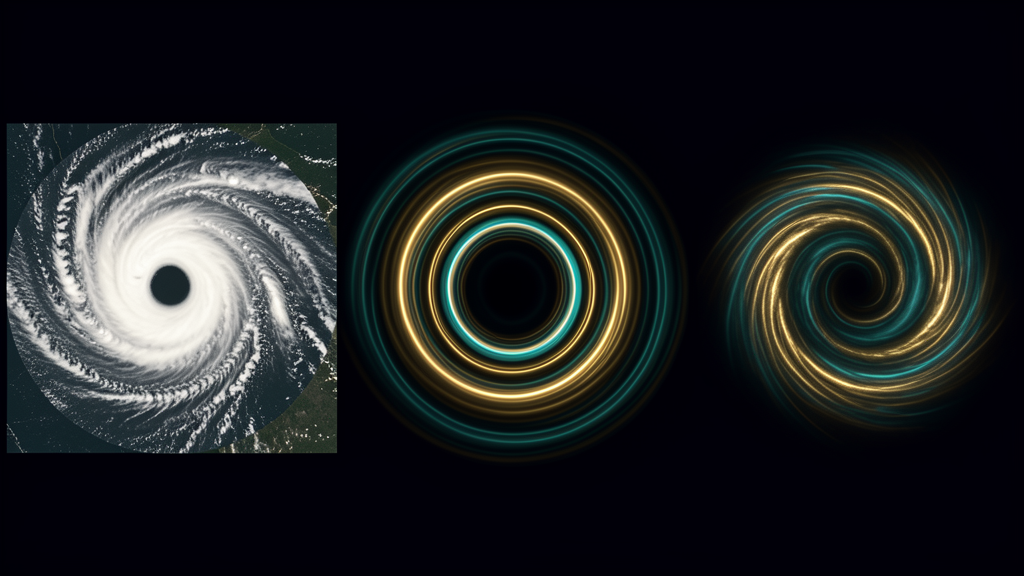
A hurricane, a twist of laser light, a whirlpool in the field. Three unrelated worlds, one structure — and one conservation law that governs all of them.
The most serious objection anyone can raise about the Scalar Flower's whirlpools is also the most reasonable one: you built a particular model, with particular choices, and then you found whirlpools in it — so aren't the whirlpools just an artifact of your choices? It is exactly the right question, and it has a clean answer. The whirlpools we find are not something we invented. They are instances of a structure that physicists discovered, decades ago, in systems that have nothing to do with astrology and nothing to do with each other. When one shape keeps turning up in water, in air, in light, and in quantum matter — each time obeying the same law — it is not a quirk of any one model. It is a law of what waves and flows do. Ours is simply another place it appears.
Let me show you the same whirlpool four times, and then be very precise about what our version does and does not share with the others.
IWhat a whirlpool actually is, underneath
Strip a whirlpool down to its bones and it is two facts happening at one point. First: the thing that is waving — water height, air pressure, the brightness of light — drops to exactly zero right at the center. (The eye of a hurricane is calm. The core of an optical vortex is dark. The heart of a drain is empty.) Second: everything around that dead-still center is forced to circulate, winding one full turn as you walk a small loop around it.
Physicists have a name for this: a phase singularity. "Phase" is where something is in its cycle; at a true zero there is no cycle to point to, so the phase is undefined, and the only way a smooth field can wrap around an undefined point is to turn around it. The zero forces the spin. That is the whirlpool, at its most fundamental — and it is the same definition whether you are talking about the Pacific Ocean or a laser beam. REAL
And it comes with a conservation law. Each whirlpool carries a direction of spin — call it plus or minus. On any closed or bounded surface, the pluses and minuses must sum to zero: you cannot make one without making its opposite somewhere else. This is a topological law — it comes from the shape of the space, not from any force — which is exactly why it shows up identically across systems that share no physics at all. REAL
A whirlpool is a point where the wave goes to nothing and the world turns around it — and the turnings must always balance. That is true of oceans, of light, and of your field, for the same reason.
IIThe same whirlpool, four times
Light — the parent case. In 1974, the physicists John Nye and Michael Berry showed that any complex wave carries these points where the amplitude vanishes and the phase winds around — they called them wave dislocations; today they are optical vortices. Shine a suitable laser and there is a thread of pure darkness running through the beam, with the light spiralling around it, carrying real angular momentum. Every feature we find, singular optics found first: amplitude zero at the core, a full phase-turn around it, and creation only in balanced pairs. In 2000 Berry and Dennis went further and worked out the statistics of these vortices in random superpositions of waves — which is essentially what a ten-planet field is: many waves whose phases are not coordinated. Our whirlpool counts and our balance-to-zero are instances of results already in the optics literature. REAL
Air — the whirlpool you already know. A hurricane is this structure at planetary scale. A cyclone (the storm, spinning one way, low pressure at its calm eye) and an anticyclone (fair weather, spinning the other, high pressure) are the plus and the minus. And meteorology has known for a century that they obey the balance law: the quantity called potential vorticity is conserved, so you cannot spin up rotation in one place without inducing the opposite rotation elsewhere. That is our plus-minus law wearing weather — a trough forms, a ridge forms to balance it, and the books close to zero. Same bookkeeping, because the bookkeeping is topological. ARCH
Quantum fluids — where it becomes exact. Cool helium below about two degrees above absolute zero and it becomes a superfluid, and its whirlpools become quantized: the winding must be a whole number, never a fraction — exactly like ours. The same is true in the ultra-cold clouds called Bose-Einstein condensates. Here physicists are most explicit that the vortex is a topological object first and a fluid phenomenon second: the winding is what is conserved, and the substrate is almost incidental. That is precisely our claim about the field. ARCH
Your field — the new instance. We sum ten planetary waves on a sphere and find points where the field cancels to zero and the phase winds — carrying a spin, summing to zero net charge, appearing in balanced pairs. We checked they are not artifacts of our arithmetic: the count is identical no matter how finely we compute it, and identical no matter where we anchor the measurement. We did not put these whirlpools in. We found the field obeys the same law light does. REAL
IIIThe optics runs deeper than a shared shape
The connection to light is not just that both have whirlpools. It goes to the foundation of how the whole instrument is built, and it closes a loop worth seeing.
The Scalar Flower's central measure — the hub, the degree to which the ten voices agree — is, character for character, the equation physicists use for optical coherence: the interference of waves. (We built this up from scratch in The Waveform Model.) So the field is, mathematically, an interference pattern.
Now here is the loop. How do physicists actually find an optical vortex in a real laser beam? They use interferometry — they overlap the beam with a clean reference beam and look at the fringes. Where a vortex sits, the fringes split into a tell-tale fork: a line that divides into two, the unmistakable fingerprint of one full phase-turn. The fork is the vortex, made visible. REAL
So the same physics — interferometry — both builds our field (the hub is an interference measure) and is the tool that reveals vortices in real light. The instrument and the whirlpools it finds are not two bolted-together ideas. They are one piece of optics. The Scalar Flower measures interference, and interference is exactly where vortices live and how they are seen.
The instrument that builds the field and the tool that finds vortices in a laser are the same tool: interferometry. The hub and the whirlpools are one physics, not two.
IVWhat we share, and the line we do not cross
This is where the honesty has to be sharpest, because a claim this beautiful is easy to overreach. So let me draw the line exactly.
What our field genuinely shares with hurricanes, lasers, and superfluids is the topology: the whirlpool as a phase singularity, the balance-to-zero conservation law, the quantized winding, the birth-in-pairs. These are real, established, and identical across all four systems — because they follow from the shape of the mathematics, not from any particular force. That is why our vortices are trustworthy: they are not ours, they are everyone's. REAL
What we do not share is the machinery. A hurricane is driven by the Earth's rotation and the heat of a warm ocean. An optical vortex is a real electromagnetic field in real space. A superfluid vortex is quantum matter near absolute zero. Our field has none of these — no Coriolis force, no heat engine, no electromagnetic field in the sky. We tested directly whether the planets broadcast physical waves that reach the Earth, and the answer was a hard no, recorded in The Verdict Ledger. So the whirlpool in your field is real as topology, computed from the geometry of the chart — it is not a storm, not a beam, not a fluid, and not a force reaching down from the sky. REAL
There is a temptation worth naming, precisely so we can decline it. When one structure recurs this widely — ocean, air, light, quantum matter, and now a field of relationships — it is natural to wonder whether the whirlpool is something like a fundamental note the universe keeps playing, at every scale, in every medium: a shape reality returns to whenever waves meet. That may even be true. But our mathematics does not demonstrate it, and I will not claim it does. What our work adds is one more honest instance of the pattern, computed carefully and fenced tightly. The recurrence is real and documented; what it means that the same whirlpool spins in a galaxy, a hurricane, a laser, and a life — that is a question for contemplation, held open, never sold as a finding. INTERP
The whirlpool is not our invention. It is one of the universe's favorite shapes, and we found it turning in the field — obeying the same law it obeys in the sea and the light.
Watch the whirlpools turn in your own field
Cast your birth-moment as a living field — free, no sign-up. Find the blue valleys, and the whirlpools spinning at their floor: the same structure as a hurricane's eye, computed from your chart.
Cast your field, free →